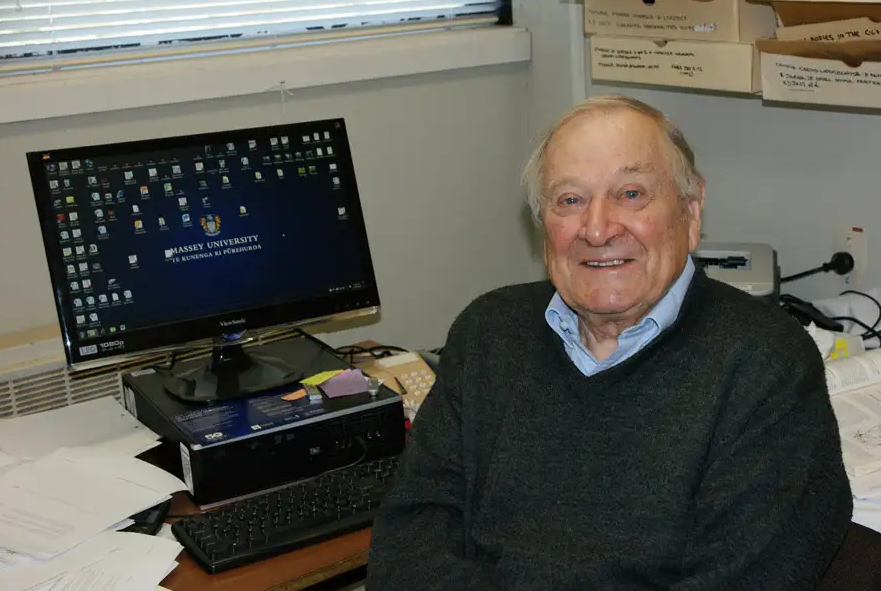
Professor Robert Dudley "Bob" Jolly was one of the pioneers of Batten disease research in New Zealand and internationally.
A veterinary pathologist and Professor Emeritus at Massey University, much of Professor Jolly's distinguished career focused on naturally occurring animal models of lysosomal storage disorders, including Batten disease (neuronal ceroid lipofuscinoses). He was instrumental in characterising the South Hampshire sheep model of CLN6 disease, which became one of the world's most important models for understanding disease pathogenesis and testing potential therapies. His work also advanced our understanding of mannosidosis and other inherited metabolic disorders.
For the Batten disease community, Professor Jolly's contributions were profound. His research laid the foundations for much of what we know about Batten disease biology today, while the sheep models developed and studied in New Zealand became critical translational tools used by researchers around the world. Generations of scientists built upon this work, with many acknowledging the pivotal role these models played in advancing the field. Recognizing the power of collaboration, Bob enlisted familiar names to our ANZ Batten community: David Palmer, leading biochemical investigations, and Nadia Mitchell, who together developed and characterized the naturally occurring CLN5-disease sheep flock found in NZ. , Working with expert global networks stretching from Cambridge and Helsinki, to Boston and Montreal, their research proved that specific protein lysosomal storage was the unifying factor across different forms of the disease.
Reflecting on this incredible impact, Prof. Jolly’s colleague Stephanie Hughes shares, “Without Bob’s curiosity, identifying and establishing the first Batten sheep flock in New Zealand, my research path would have been entirely different. From the early days of him or I driving between Wellington and Palmerston North with sheep samples to more recently working with Bob to identify storage material in a Takahe (NZ endangered bird), Bob has been a huge influence. Forever the father of lysosomal storage disorders in New Zealand. You will be missed, Bob. “
More recently, Prof. Bob Jolly was immensely proud to see his pioneering work in Batten disease translated into the development of a viral vector-mediated gene therapy for CLN5 disease. Preclinical studies evaluating AAV9-CLN5 gene therapy in the naturally occurring CLN5 sheep model, across multiple doses and routes of administration, demonstrated meaningful preservation of neurological function and significantly extended survival. These landmark studies were instrumental in supporting Neurogene Inc.'s Investigational New Drug (IND) application, with the U.S. Food and Drug Administration (FDA) subsequently clearing the program to proceed into the first-in-human Phase 1/2 clinical trial of dual intracerebroventricular and intravitreal AAV9-CLN5 gene therapy, which commenced in 2022.
Early and interim clinical results have been encouraging, providing hope that gene replacement therapy may meaningfully alter the course of CLN5 disease. However, despite these promising findings, the future of the program has unfortunately been overshadowed by financial challenges, resulting in the indefinite suspension of clinical development while the company explores alternative pathways to advance this otherwise highly promising therapy.
Prof. Jolly's vision and scientific legacy continue to inspire researchers, clinicians, families, industry partners and advocates around the world. Advancing effective therapies for CLN5 disease remains a shared mission of the global Batten disease community, and one that BDSRA and its partners remain deeply committed to pursuing in his honour.
Professor Jolly's remarkable contributions were recognised through numerous honours, including election as a Fellow of the Royal Society Te Ap?rangi in 1985, the award of the Hector Medal in 1995, and appointment as a Member of the New Zealand Order of Merit in 2005 for services to veterinary science. He also received the Massey Medal during the Vet School's 50th anniversary in 2013, reflecting a career that spanned nearly 70 years and included authoring 188 scientific articles, the final paper remarkably published in October 2025 when he was aged 95. He is remembered as a true legend of the profession who valued rigorous thinking, encouraged deep collaboration, and inspired those he taught and mentored to pursue meaningful questions.
Dr Nadia Mitchell shares, “Well into his nineties, Bob retained an extraordinary command of lysosomal disorders in livestock. His memory for facts was remarkable, his questions were always thought-provoking, and his enthusiasm for Batten disease never waned. Whenever the phone rang, I knew I would be in for a stimulating conversation. His curiosity, sharp intellect, and enduring passion for science were truly inspiring. His contribution to the field will not be forgotten.”
While many families affected by Batten disease may never have known Professor Jolly's name, they have nonetheless benefited from his curiosity, scientific rigour, and unwavering commitment to improving understanding of these devastating disorders. His legacy lives on in the discoveries he made possible, the researchers he inspired, and the hope his work helped create for future generations.
On behalf of BDSRA Australia, we extend our sincere condolences to Professor Jolly's family, friends, colleagues, and former students, and offer our deepest gratitude for a life dedicated to advancing science in the service of others.